
Author: Laura Altin
-
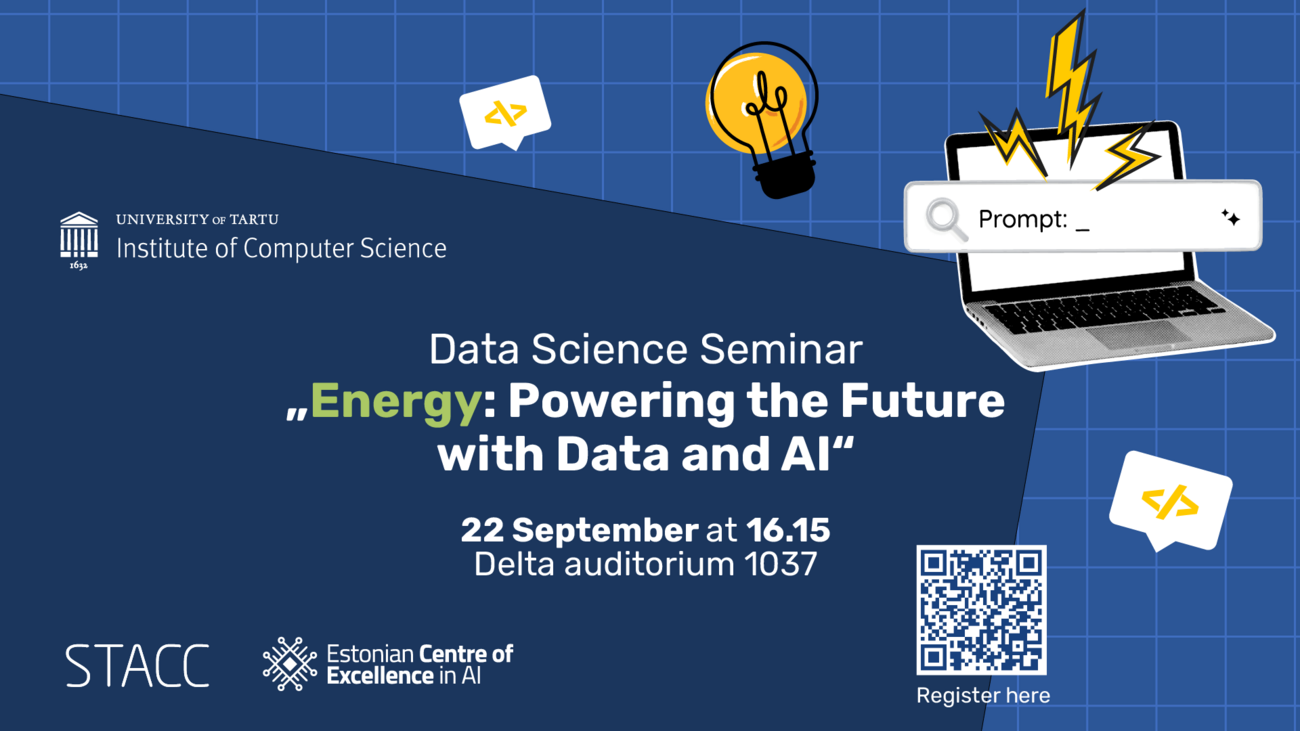
Data Science Seminar “Energy: Powering the Future with Data and AI”
Data Science Seminar “Energy: Powering the Future with Data and AI” will take place 22 September from 16:15 at Delta auditorium 1037. As more electricity comes from renewable sources such as wind and solar, electricity production becomes increasingly dependent on weather conditions. At the same time, electricity demand is rising due to the electrification of…
-
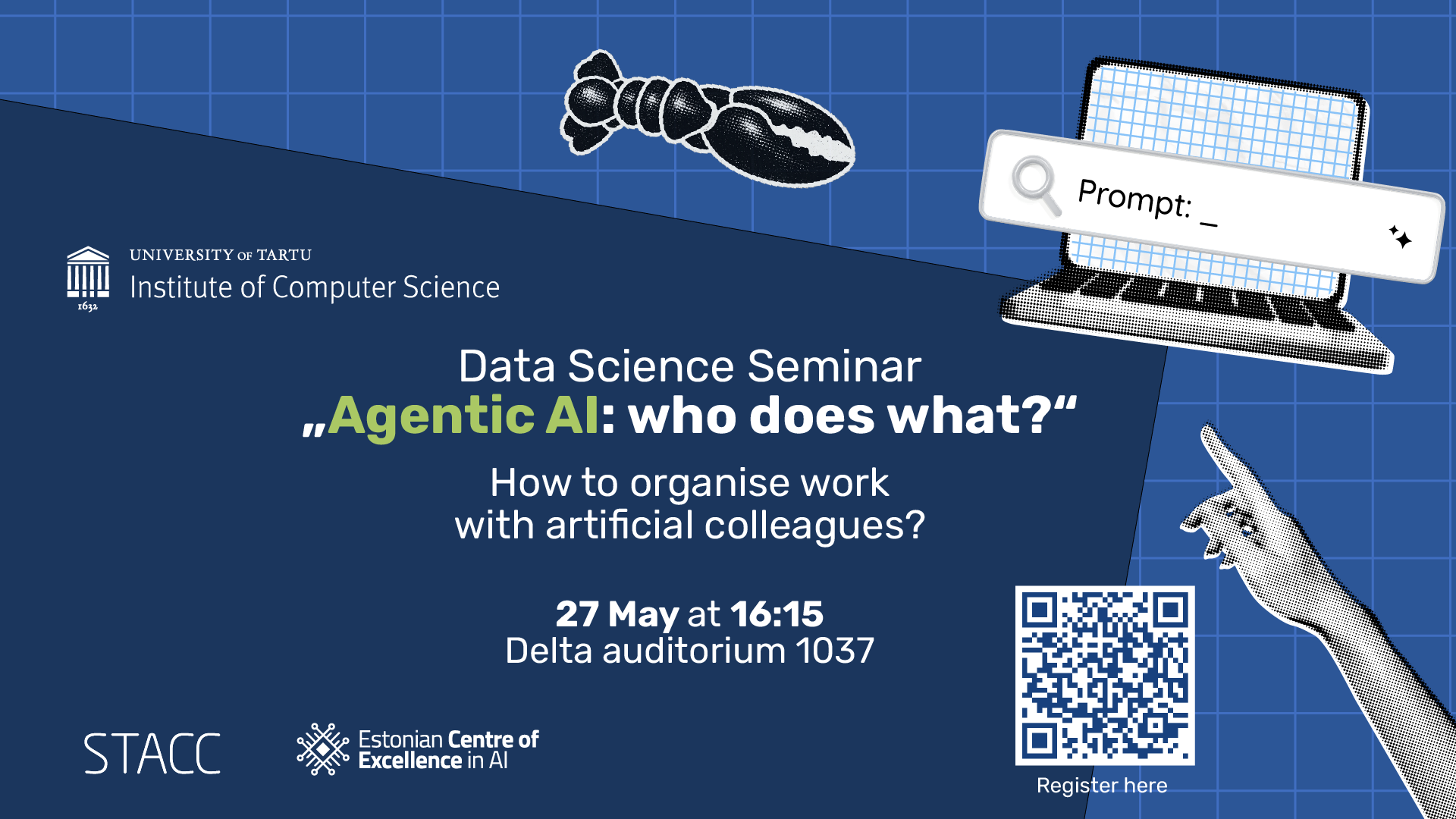
Data Science Seminar “Agentic AI: Who Does What?”
The Data Science Seminar takes place 27 May from 15.45 in the Delta auditorium 1037. How to organise work with artificial colleagues? With the adoption of agentic AI, the focus shifts from individual tools to systems in which humans and AI agents work, make decisions, and act together. This raises a central question: who does…
-

Data Science Seminar: Creating Impact from Real-World Health Data
The Data Science Seminar “Creating Impact from Real-World Health Data” takes place 18 March from 15.45 in the Delta auditorium 1037. Real-World Health Data (RWD) is expanding at unprecedented scale-generated through every clinical encounter, diagnosis, laboratory measurement, prescription, procedure, and health-related transaction. These digital traces form a high-resolution map of how health systems function in…
-

Kaarel Hänni talk about “AGI Safety” on january 7th
This Wednesday, on January 7 at 14:00, Kaarel Hänni will give a talk entitled “AGI Safety” in room 1018. The talk will be held in English. Kaarel Hänni is an AI Safety Research Scientist at Mila – Quebec Artificial Intelligence Institute, focusing on the development of safe AI for the benefit of humanity. Abstract (in…
-
WUML2026
Workshop on Uncertainty in Machine Learning (February 2-4 2026 in Tartu, Estonia) Motivation and Focus The notion of uncertainty is of major importance in machine learning and constitutes a key element of modern machine learning methodology. In recent years, it has gained in importance due to the increasing relevance of machine learning for practical applications,…
-
RBO13. AI in education
Primary focus area: AI for e-governance Secondary focus areas: adaptation of foundation models Abstract This project aims to develop AI tools that support self-regulated learning (SRL) in schools, aligning with how the human brain learns. These tools will be grounded in cognitive science to ensure reliability, trust, and real-world applicability. Small-scale classroom experiments will validate…
-
RBO10. Leveraging LLMs for Complete Life-cycle of Cyber Security Analytical Tasks
Primary Focus Area: AI for CybersecuritySecondary Focus Areas: Hybrid AI pipelines, Adaptation of foundation models, Safeguards and trust in AI, Privacy and security in AI, AI for e-governance, AI for healthcare, AI for business processes AbstractCyber threats are growing in scale and complexity, producing massive volumes of security data that challenge timely analysis. This RBO…
-
RBO9. Adaptive Data-Driven Optimisation of Business Processes
Primary focus area: AI for business processesSecondary focus areas: safeguards and trust in AI; AI for e-governance Abstract This project develops methods for real-time, adaptive optimization of business processes using structured and unstructured data. By detecting performance degradations, diagnosing their causes, and recommending data-driven interventions, the approach shifts from static process redesign to dynamic, operational-level…
-
RB06. Methods for using AI to create a synthetic digital twin of the Estonian population
Primary focus area – F5: AI for e-governanceSecondary focus areas – F1: hybrid AI pipelines, F2: adaptation of foundation models, F6: AI for healthcare, F8: AI for cybersecurity Abstract This project develops AI-based methods for generating a realistic, privacy-preserving synthetic digital twin of the Estonian population. Initial efforts focus on synthesizing data from the population…
-
RBO5. Cloud-compatible, end-to-end encrypted AI service blueprint
Primary Focus Area: Privacy and Security in AISecondary Focus Areas: Adaptation of Foundation Models; AI for Cybersecurity Abstract:This RBO aims to prototype secure, cloud-based AI workflows using privacy-preserving computation methods like secure multi-party computation (MPC), federated learning, and trusted execution environments (TEEs). These technologies can enable sensitive data to be used in training and inference…